Questions & Discussion Prompts
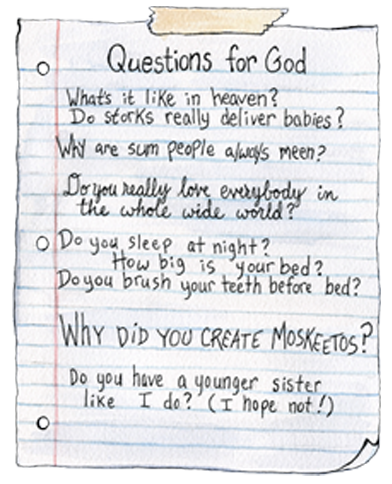
We know that kids ask tons of questions! The Oak Street books create great opportunities to talk with your kids about God and faith. Here are several questions kids may ask and tips that will help springboard discussions. We’ve included references to Bible verses that tie in with each prompt.
 Parenting 101: Wise Boundaries Parenting 201: Breaking a Child’s Spirit
When the Apostle Paul writes to parents in the church in Colossae, he says this: “Do not embitter your children, or they will become discouraged” (Colossians 3:21).
A discouraged child doesn’t fight. They are probably not allowed to. A discouraged child withdraws. It is about the collapse of their inner spirit when they conclude that they will never satisfy the expectations of their parents. The parent’s behavior results in the child’s inner state. Parents can be right and still damage their child’s heart. It is all about how authority is exercised. Repeated harshness doesn’t produce obedience. It results in the loss of heart. James was the brother of Jesus who led the first church in Jerusalem. Read his advice as a place to start in changing your approach to parenting imperfect children.
Parenting 301: How to Handle the ProdigalWhen a child is a prodigal, it can be emotionally exhausting and stretch the entire family spiritually questioning God’s whereabouts. Luke 15:11-3 is a parable of Jesus that pictures the prodigal as someone who rejects God’s wisdom, walks away from God (or family), and chooses a pathway of self-destruction.
- The father in the story never stopped loving his son, even though he did not chase after him. In these seasons of parenting, guard your heart from bitterness or self-blame. Pray for a compassionate spirit of mercy and grace rather than self-righteous judgment.
- Tough love never enables destructive behavior or parent’s felt need to protect their son or daughter from the consequences of their choices. Set clear boundaries for yourself while speaking the truth in grace. God allows the natural consequences of our decisions to be our most effective teacher.
- Keep the door unlocked and keep the light on without trying to force reconciliation. Never plead or emotionally pressure the prodigal. The father just kept watching from a distance.
- Pray for a wake-up call (Luke 15:17). Prodigals are more apt to return when they know they will be welcomed in grace rather than judgment over what they have done to the family name. Prepare for their return and allow time for trust to be restored in both directions.
- Have the party supplies ready or the phone number for reservations at their favorite restaurant to celebrate if and when the prodigal returns.
Parenting 401: Training for a LifetimeSolomon was known as the wisest person who ever lived (1 Kings 4:29-34). He is credited with the wisdom in Proverbs 22:6: “Train up a child in the way he should go; even when he is old, he will not depart from it.”
- Consistent modeling, not just instruction.
- Repeated habits, not one-time talks.
- Shaping life values and instincts, not merely modifying their behavior when you are watching.
- Paying attention to a child’s innate temperament, strengths, and wiring.
- Guiding them toward personal growth and development consistent with who they are, not who you want them to be.
- Avoiding one-size-fits-all parenting so you parent each child uniquely.
Will not depart offers a word of hope. What a child learns early usually comes back to guide them later on. The path you help them learn and walk early often becomes the one they return to. The verse does not deny seasons of wandering off that course. Rather, it suggests a hopeful investment early in life:
- Early formation creates lifelong inner values that guide decisions.
- What is internalized early becomes a compass, even when resisted along the way.
- Solomon’s wisdom challenges both extremes: (1) Control-based parenting: forcing compliance without heart formation, and (2) Hands-off parenting: assuming children will “figure it out.”
A Kid’s Christmas Story
A long time ago, in a town called Nazareth, lived a young woman named Mary. One day an angel appeared and told her something amazing: She was going to have a special baby—God’s Son—and His name would be Jesus. Mary trusted God and said “Yes.”
Mary was engaged to Joseph, a kind man who also loved God. When Joseph heard the news, he wasn’t sure what to do. But an angel came to him in a dream and said, “Don’t be afraid. This baby is from God” So Joseph stayed with Mary and took care of her.
Soon it was time for everyone to go to their hometown to be counted in a census. Joseph and Mary had to travel all the way to Bethlehem. It was a long, bumpy trip, and when they arrived, the town was packed with people. Every place to stay was full.
No room anywhere.
Finally, someone let them stay in a quiet stable where animals slept. And that night, Jesus was born. Mary wrapped Him in soft cloths and laid Him in a manger, a feeding box for animals. It wasn’t fancy, but it was warm and safe.
On a hillside nearby, some shepherds were watching their sheep. Suddenly, the night sky lit up with an angel who said: “Don’t be afraid! I bring good news for everyone. Today, in Bethlehem, a Savior has been born! He is Christ the Lord.” Then the sky filled with angels singing “Glory to God in the highest!.” The shepherds hurried to Bethlehem. They found Mary, Joseph, and baby Jesus in the stable—just like the angel said. They were so excited that they told everybody what they had seen.
Far away, Wise Men noticed a new, bright star. They knew it meant a special King had been born. They followed the star all the way to find Jesus. When they found Him, they bowed down and gave Him gifts—gold, frankincense, and myrrh. Everyone who met Jesus knew something wonderful had happened.
- God had come to live near us.
- A Savior had been born to forgive our sins.
Who is your favorite person in the Christmas story—and why?
- Mary — because she trusted God.
- Joseph — because he protected Mary and Jesus.
- Baby Jesus — because He is the center of the story.
- The Shepherds — because they were surprised and got to see the angels.
- The Angels — because they sang the good news.
- The Wise Men — because they followed the star and brought gifts.
- The Star (younger kids pick this!) — because it showed the way.
If you could be anyone in a Christmas play, who would you want to be?
More Discussion Questions:
A Summary of the importance of Christmas
#1 - God Keeps His Promises
Jesus’ birth fulfilled what God said long before.
#2 - God Sent His Son for Everyone
Jesus came for shepherds, wise men, and all of us today.
#3 - God Uses Ordinary People
Mary, Joseph, shepherds—none were famous, but God chose them.
Optional Activity
Draw your favorite part of the Christmas story.
- Psalm 139:13-14,16 - You made my whole being. You formed me in my mother’s body. I praise you because you made me in an amazing and wonderful way. What you have done is wonderful. I know this very well…you saw my body as it was formed. All the days planned for me were written in your book before I was one day old.
- Ephesians 2:10 - God has made us what we are (a “masterpiece”). In Christ Jesus, God made us new people so that we would do good works. God had planned in advance those good works for us. He had planned for us to live our lives doing them.
- 1 Peter 4:10 - Each of you received a spiritual gift. God has shown you his grace in giving you different gifts. And you are like servants who are responsible for using God’s gifts. So be good servants and use your gifts to serve each other.
- Matthew 5:43-44 - “You have heard that it was said, ‘Love your neighbor and hate your enemies.’ But I tell you, love your enemies. Pray for those who hurt you."
- Luke 6:27-28 - “I say to you who are listening to me, love your enemies. Do good to those who hate you. Ask God to bless those who say bad things to you. Pray for those who are cruel to you."
- Romans 12:20 - “If your enemy is hungry, feed him; if your enemy is thirsty, give him a drink. Doing this will be like pouring burning coals on his head.” Do not let evil defeat you. Defeat evil by doing good.
- John 15:12 - “This is my command: Love each other as I have loved you.”
- Psalm 121:3-7 - He will not let you be defeated. He who guards you never sleeps. He who guards Israel never rests or sleeps. The Lord guards you. The Lord protects you as the shade protects you from the sun. The sun cannot hurt you during the day. And the moon cannot hurt you at night. The Lord will guard you from all dangers. He will guard your life.
- Proverbs 3:23-26 - Then you will go on your way in safety. And you will not get hurt. You won’t need to be afraid when you lie down. When you lie down, your sleep will be peaceful. You won’t need to be afraid of trouble coming suddenly. You won’t need to fear the ruin that comes to the wicked. The Lord will keep you safe.
- Psalm 18:28 - Lord, you give light to my lamp. My God brightens the darkness around me.
- 1 John 5:14 - We can come to God with no doubts. This means that when we ask God for things (and those things agree with what God wants for us), then God cares about what we say.
- Jeremiah 29:12 - Then you will call my name. You will come to me and pray to me. And I will listen to you.
- Psalm 17:6 - I call to you, God, and you answer me. Listen to me now. Hear what I say.
- Matthew 6:19-23 - Our Father in heaven, we pray that your name will always be kept holy. We pray that your kingdom will come. We pray that what you want will be done, here on earth as it is in heaven. Give us the food we need for each day. Forgive the sins we have done, just as we have forgiven those who did wrong to us. And do not cause us to be tested; but save us from the Evil One.
- John 14:1-4 -Jesus said, “Don’t let your hearts be troubled. Trust in God. And trust in me. There are many rooms in my Father’s house. I would not tell you this if it were not true. I am going there to prepare a place for you. After I go and prepare a place for you, I will come back. Then I will take you to be with me so that you may be where I am. You know the way to the place where I am going.”
- Revelation 21:4 - He will wipe away every tear from their eyes. There will be no more death, sadness, crying, or pain. All the old ways are gone.”
- Isaiah 25:6-8 - The Lord of heaven’s armies will give a feast. It will be on this mountain for all people. It will be a feast with the best food and drink…On this mountain God will destroy the veil that covers all nations. This veil, called “death,” covers all peoples. But God will destroy death forever. The Lord God will wipe away every tear from every face.
- 1 Thessalonians 4:13-18 - We want you to know about those who have died. We do not want you to be sad as others who have no hope. We believe that Jesus died and that he rose again. So, because of Jesus, God will bring together with Jesus those who have died…And we will be with the Lord forever. So, comfort each other with these words.
*All verses from the International Children’s Bible (ICB)
Share This Page